The Lucas Museum of Narrative Art will open its doors on September 22, 2026 at Exposition Park in Los Angeles. George Lucas and Mellody Hobson have invested approximately one billion dollars in this project. It wasn't a quick decision: the museum traversed more than a decade of reconsiderations, moving from San Francisco to Chicago before finding its final form in California.
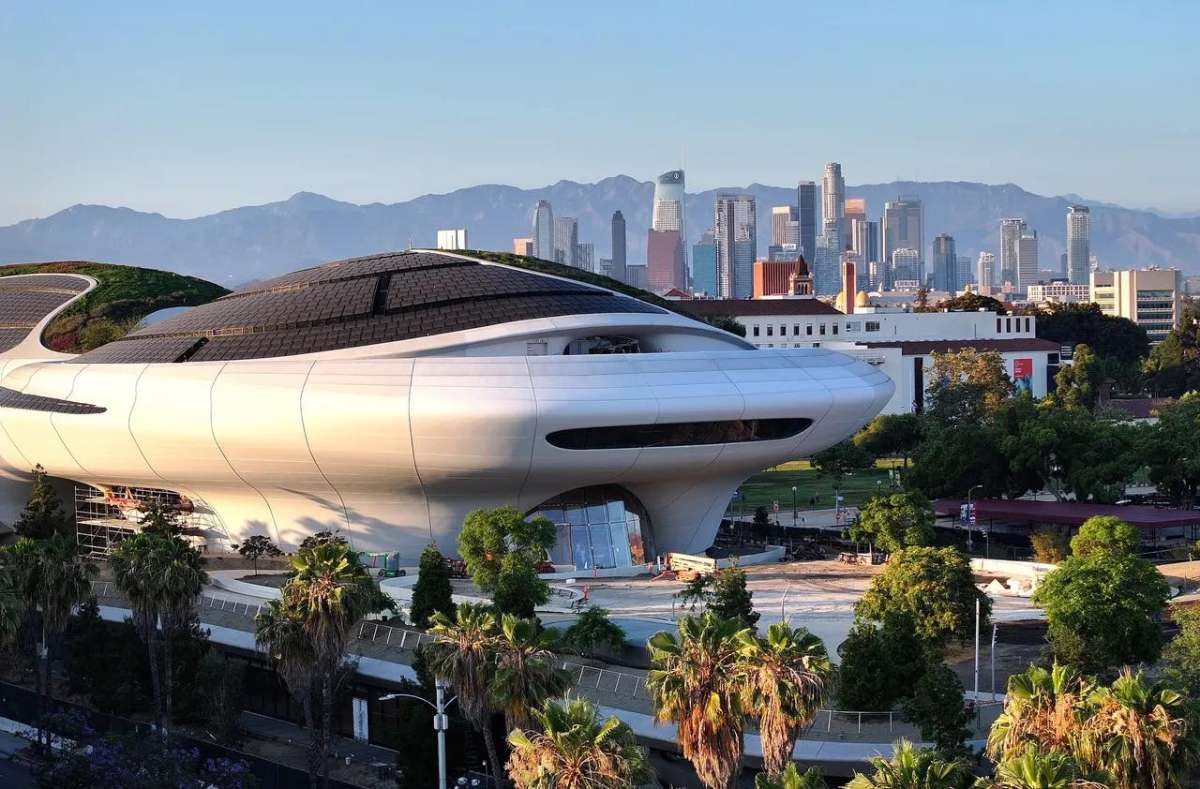
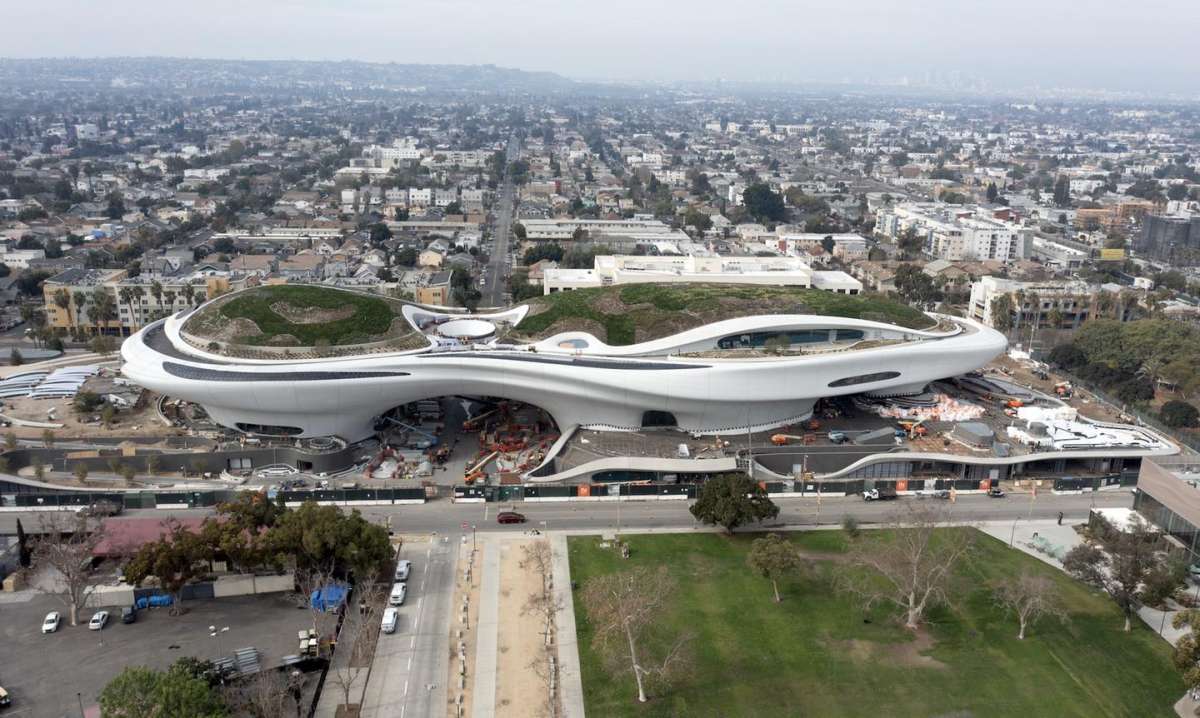
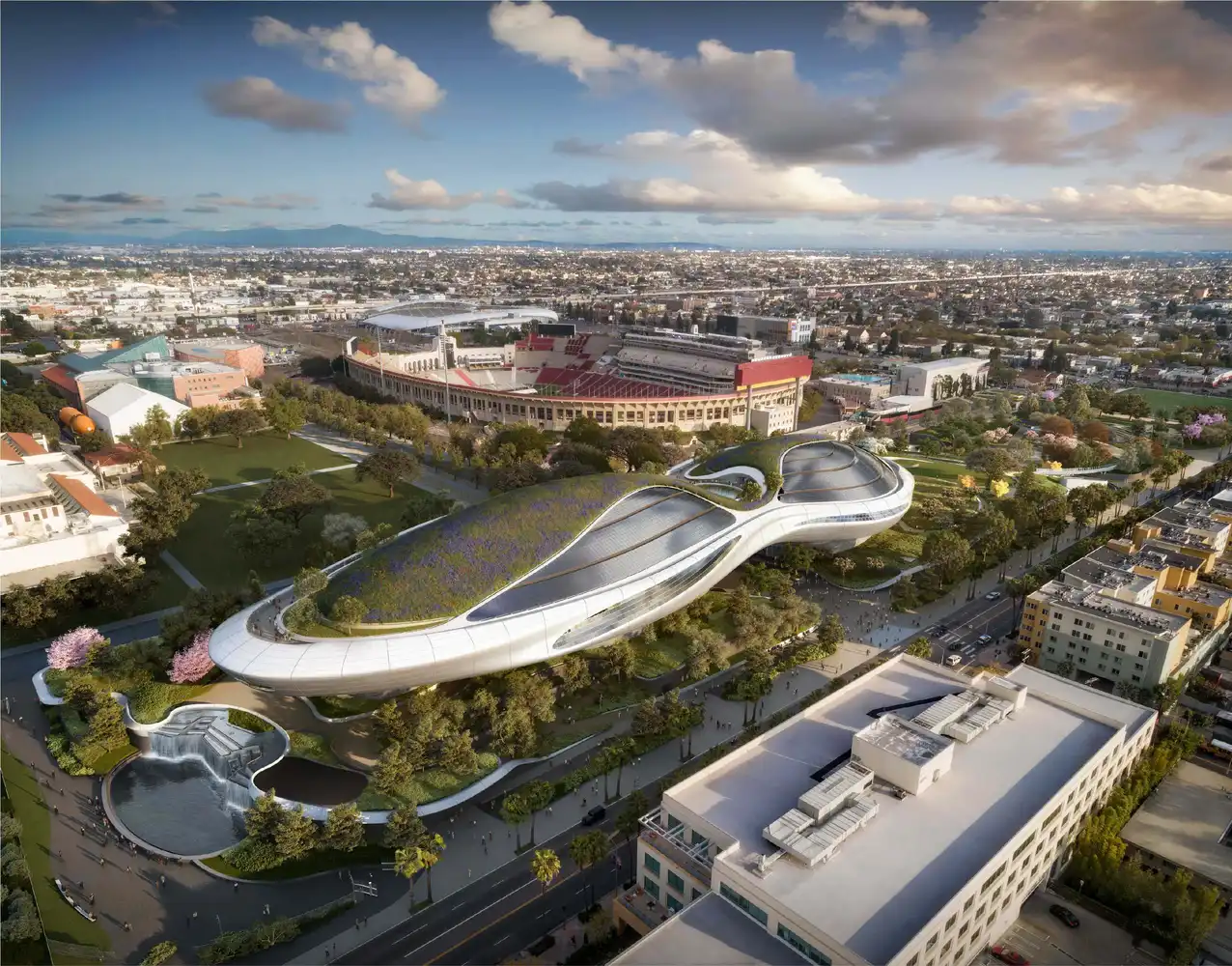
Chinese architecture studio MAD Architects, led by Ma Yansong, designed a structure that challenges traditional geometry. An undulating biomorphic form that resembles a cloud or spacecraft. Alongside, landscape designer Mia Lehrer (Studio-MLA) and studio Stantec coordinated an intervention across eleven acres, transforming asphalt parking lots into green space where nature and architecture breathe together.
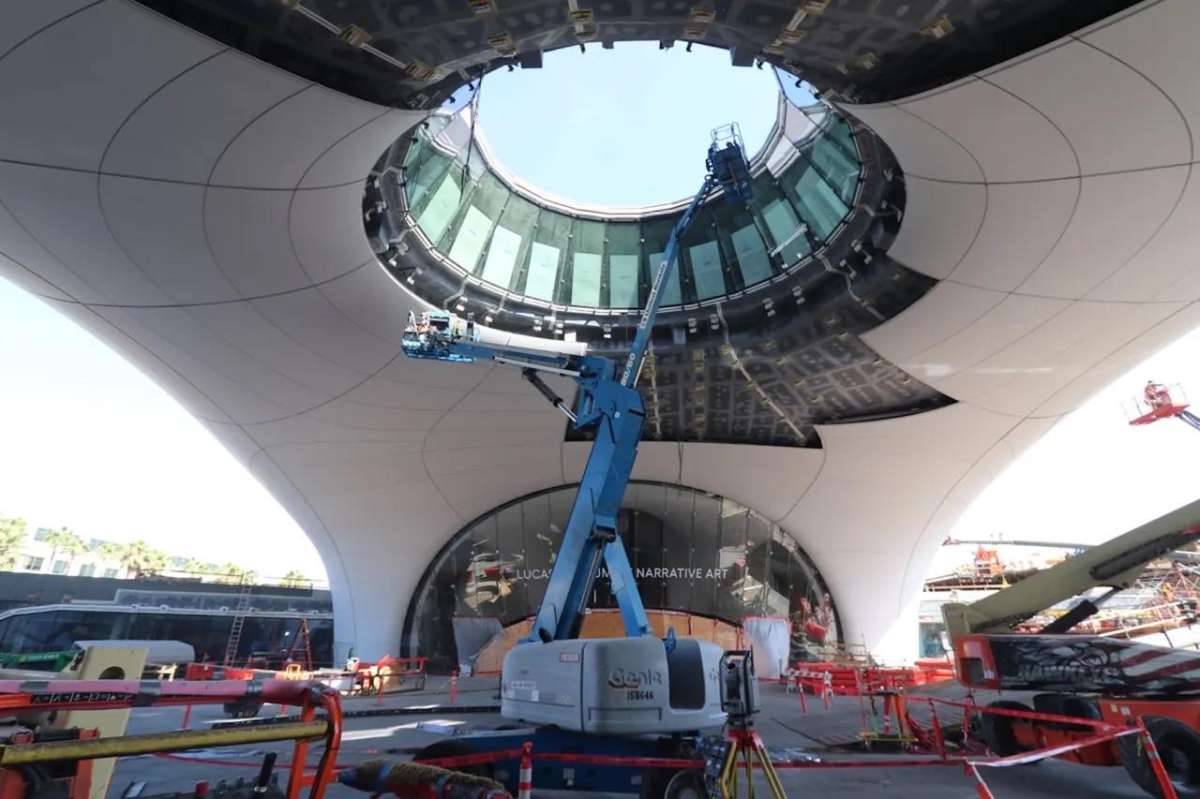
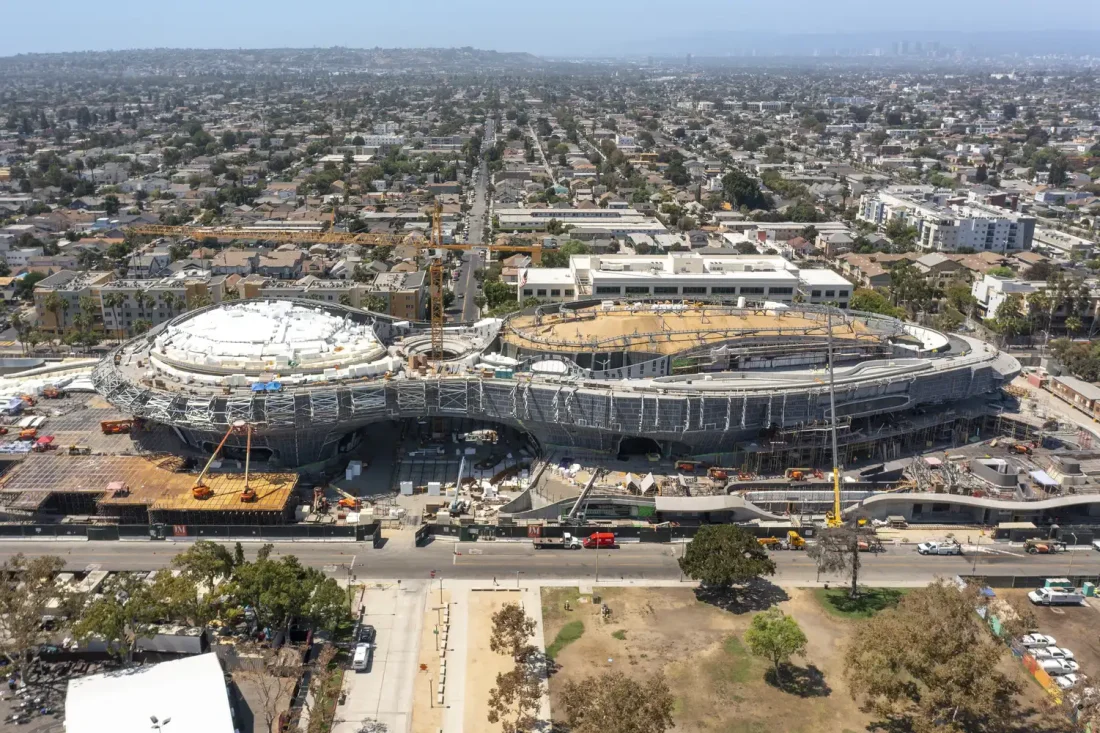
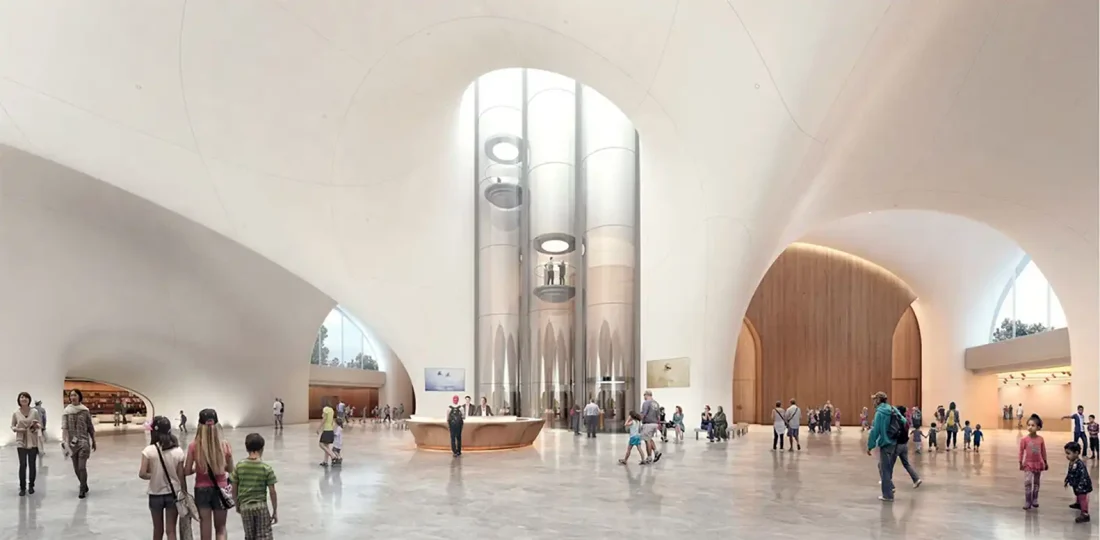
The building reaches five stories across three hundred thousand square feet. A central arch spanning one hundred eighty-five feet extends toward a public plaza, creating a physical opening toward the city. Inside, an Oculus elliptical—suspended four stories above ground—pierces through all levels, becoming the visual heart where visitors gather. The undulating silhouette is no accident. It draws inspiration from the grand oaks of Exposition Park and extends their natural canopy upward.
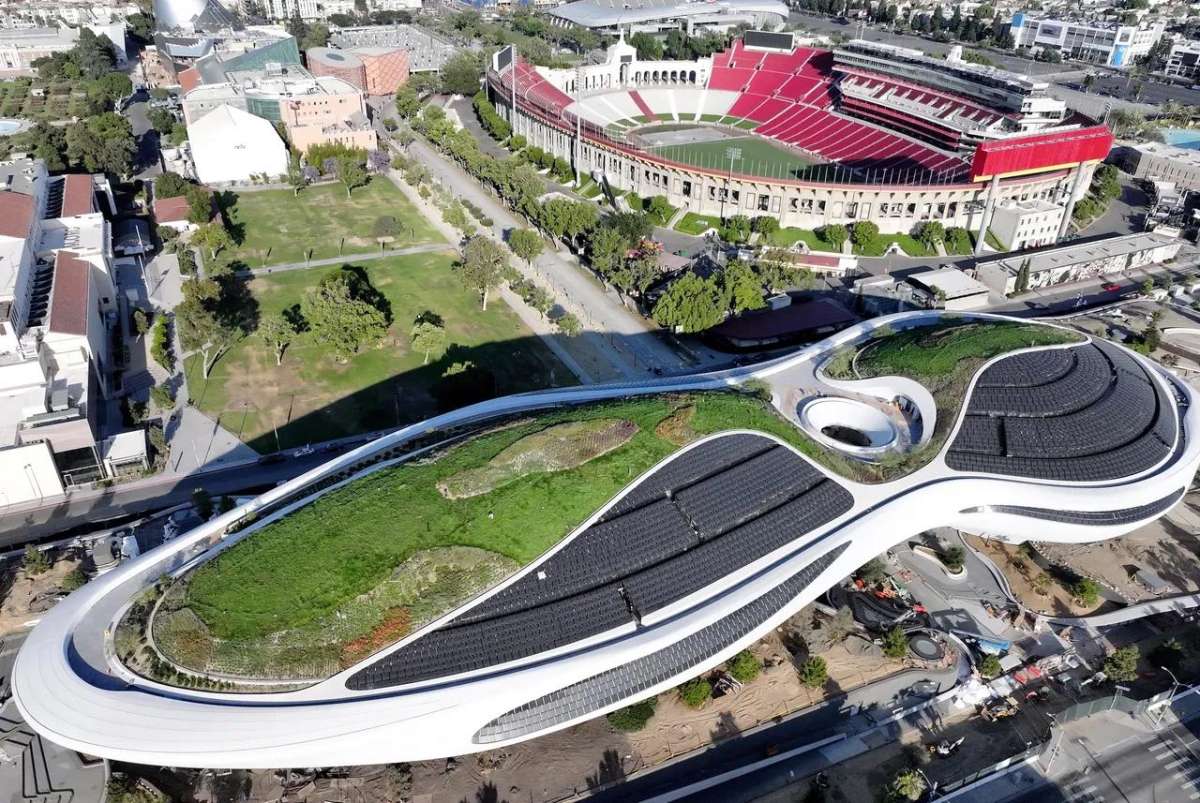
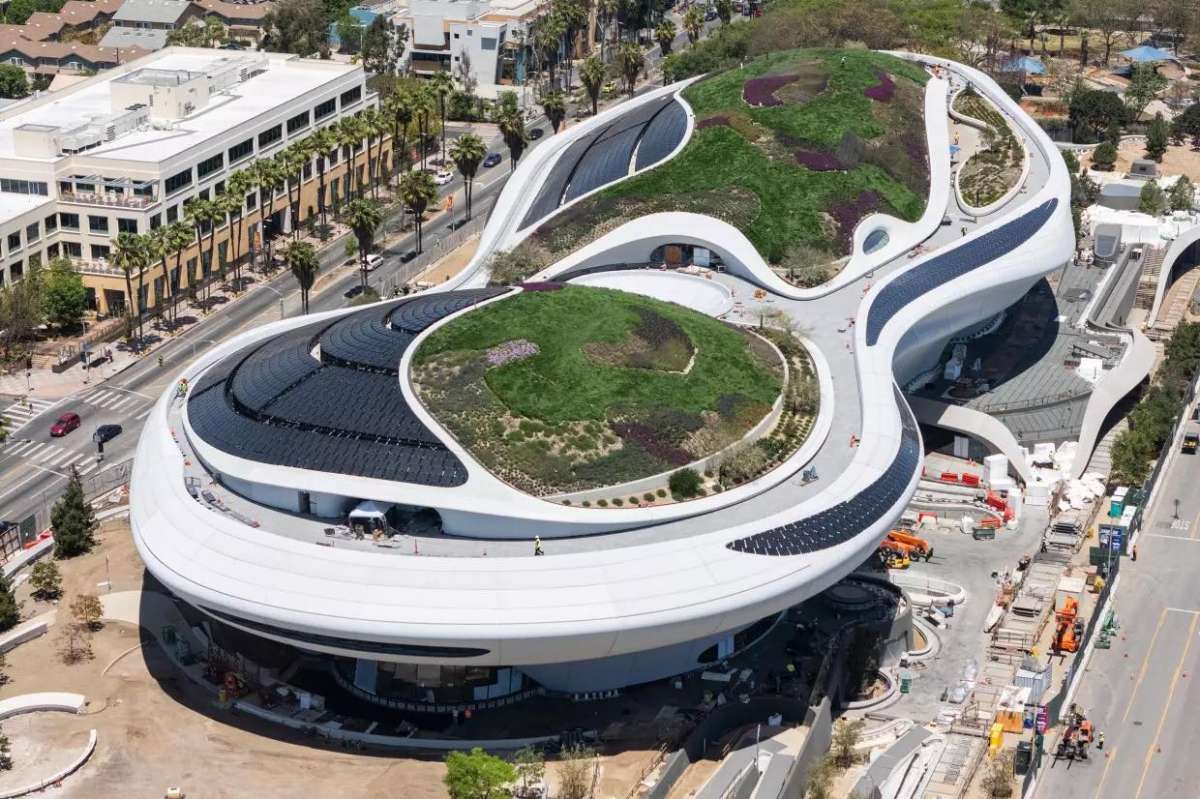
Over fifteen hundred fiberglass-reinforced polymer panels clad the roof. Each one is unique in form. This construction approach reverberates through interior spaces: the museum deliberately rejects the right angle. The galleries are fluidly curved, mirroring external geometry. Thirty-five thematic galleries distribute across over one hundred thousand square feet of exhibition space. Love, family, work, adventure, childhood, sport. Themes that order the artworks without confining narrative.
Los Angeles is a high-seismic-risk city. MAD solved the problem with an unusual structural idea: the building is constructed "like a giant ice skate." A space of roughly forty-two inches separates the structure's perimeter from the ground on each side. During an earthquake, the museum can shift laterally. It doesn't collapse. It doesn't fracture. It's one of the city's safest urban places to be during a quake. Steel framework and roof combine green space with solar panels.
The galleries will house over forty thousand artworks. The collection begins with Roman mosaics, continues through Renaissance paintings, arrives at contemporary photography. It's not a linear progression. It's continuous dialogue across centuries. Visitors will encounter Norman Rockwell, Frida Kahlo, N.C. Wyeth, John Singer Sargent, Robert Colescott. Artists who shaped generations of iconography. Alongside them, cartoonists. Jack Kirby, R. Crumb, Alison Bechdel, Chris Ware. They molded the graphic language of popular culture. The museum will also hold the Lucas Archives. Models, costumes, props, concept art from Star Wars films and related projects. It's not a sealed private archive. It's documentation open to the public. It allows anyone to understand how images become mythology.
The landscape intervention adds further layers. Two hundred native drought-resistant trees are already planted on site. A suspended garden, amphitheater, pedestrian bridge, cascading fountain. The museum was conceived three times. In 2012, San Francisco rejected it. Then it was redesigned for Chicago. Neither worked. Los Angeles embraced it. During construction, roughly sixty percent of the workforce comes from the county. Priority goes to locally-owned businesses, women, and minorities.
George Lucas stated: "Stories are mythology, and when illustrated, they help mankind understand the mysteries of life." Mellody Hobson added: "This is a museum of popular art. Images are illustrations of beliefs we live with every day. For this reason, this art belongs to everyone." The board of directors includes filmmakers Guillermo del Toro and Steven Spielberg, alongside representatives from national cultural institutions.
About the Museum
The Lucas Museum of Narrative Art is the world's first museum dedicated exclusively to illustrated visual narrative. It brings together painting, sculpture, muralism, photography, comics, editorial illustration, and cinematic arts. The collection spans vast historical ground: from ancient mosaics to historical comics, from contemporary illustrators to personal archives tied to Star Wars. The building unfolds across five levels with thirty-five galleries organized by narrative theme. It houses two theaters with two hundred ninety-nine seats each, a horseshoe-shaped library, ten teaching studios, museum shop, restaurant, and café. The structure uses an innovative seismic system that allows the building to shift during earthquakes. The eleven-acre site includes two hundred native trees, suspended garden, amphitheater, pedestrian bridge, and fountain. Official public opening occurs September 22, 2026.
Glossary
- MAD Architects: Architecture studio founded by Ma Yansong in Beijing. Known for organic projects that integrate biomorphic forms with landscapes and urban contexts. Significant prior works include the Absolute Towers in Toronto.
- Liminal space: A zone of transition between interior and exterior, public and private. Here, a place where the museum merges architecture, landscape, and community into continuous experience.
- Biomorphic: A form that mimics organic natural patterns, like trees, waves, or living bodies. Opposite of rigid angular geometry.
- Fiberglass-reinforced polymer (FRP): A lightweight and durable composite material. Glass fibers and resin. Used here in the fifteen hundred unique panels of the external roof.
ArchDaily — MAD Architects' Lucas Museum Reveals Latest Construction Details (September 26, 2022). https://www.archdaily.com/989568/mad-architects-lu...
Parametric Architecture — Lucas Museum by MAD Architects to Open Its Doors in 2026 in LA (January 26, 2025). https://parametric-architecture.com/lucas-museum-m...
Metropolis Magazine — What's Behind George Lucas's MAD Choice for His New Museum (November 21, 2022). https://metropolismag.com/viewpoints/whats-behind-...